← All help topics

Getting started

The Dashboard

The first screen after you sign in. With one business page the Dashboard is that page — what to do next, how it is doing, and one tap into each product. With more than one it is all of them together.

தமிழில் படிக்க

Steps

  1. Your page is the first thing on the screen: its logo, its name, whether it is live, and the address customers type. Beside the address sit Copy link, Share on WhatsApp, QR code and Open page; under it, Edit page. This is not a summary of a screen somewhere else — it is the page itself.

  2. Next steps is the checklist below it, headed by how many things are left to do. Each line names one thing this page is missing and opens the screen that fixes it. Not now puts a line away for a while rather than for good, and an item you finish disappears on its own. When there is nothing left it collapses to one line instead of inventing work.
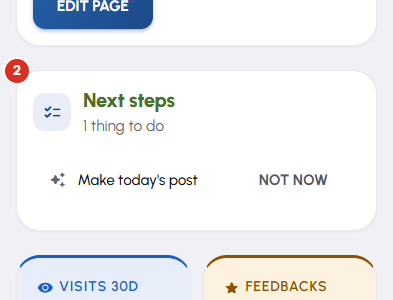
    The Dashboard — 2
  3. Then four numbers about this page. Visits counts the last thirty days, with the last seven underneath. Feedbacks counts the ratings customers left, with the average. Leads counts the enquiries, bookings and chat leads it has taken. Renewal counts down to the day the plan is due. Tap one to open the screen behind it — Analytics, Feedbacks, your leads and Subscriptions, in that order.
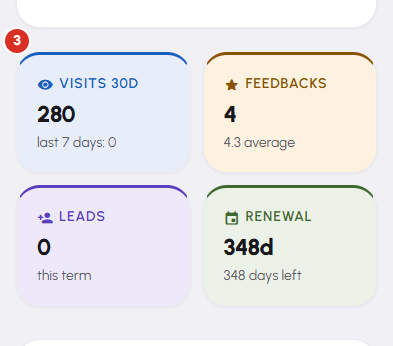
    The Dashboard — 3
  4. Under that, one card per product: Business Page, AI Chat, Review Engine and Social Media. Each says what state that product is in for this page — how many steps are left, whether the assistant is answering, how many review campaigns have gone out, when the last post was — and its button takes you in. The AI Chat button reads Turn on until the assistant is set up, and Open afterwards.
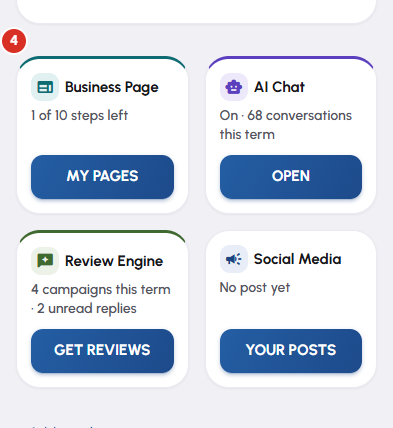
    The Dashboard — 4
  5. With more than one page the Dashboard is about the account instead. Totals across every page come first, then Your pages: one row per page with its logo, its name, whether it is live, a chip counting the steps still open on it, an Edit button, and a menu holding that page's other screens. Tap a row to work on that page. The header carries Add another page.

Questions

Visits is the last thirty days on your public business page — the page your customers see, not this dashboard. Feedbacks is every rating that page has collected, with its average. Leads is the enquiry forms, appointment bookings and AI Chat leads it has taken in the current plan term. Renewal is how long is left before that page's plan is due.

With one page, that page. The Dashboard is its home, and everything on it — the checklist, the numbers, the product cards — is about it. With more than one, the Dashboard is the account: totals across all of them first, then a row for each so you can pick. It swaps over by itself the day you add a second page, and swaps back if you are down to one again. There is nothing to set.

That page's plan comes up for renewal. Plans belong to a page and not to your account, so a second page has its own date and its own countdown — one of your pages can be on a paid plan while another is free. Subscriptions lists them side by side and is where you renew.

It was a row of shortcuts to screens that are already one tap away. The pills across the top of every screen carry the products, and the menu button opens a sidebar listing every section there is. The jobs about your page itself — Edit, Share, the QR code, Open — are on the page at the top of the Dashboard.

Here, so the cards can use that room to tell you where your page stands instead. Business Page: Your public page — contact details, gallery, services, timings and reviews, on your own bizgo.in link. AI Chat: An assistant on your page that answers visitors from your own content and drops the leads into Contacts. Review Engine: Ask happy customers for a Google review over WhatsApp, and follow up automatically when they don't reply. Social Media: A branded post for your business every day, picture and caption, ready to share wherever your customers are. One thing to be clear about on the Review Engine: the automatic part is the writing and the timing. You press send yourself, from your own WhatsApp — BizGo never messages a customer of yours.

On Subscriptions. Receipts and renewal reminders go to one address for your whole account, and it now sits with the plans and payments it belongs with rather than as a banner that never went away. If there is no address on file yet, the Dashboard still asks for one, and that prompt goes when you answer it.

Press the Dashboard pill at the top of the screen, or the BizGo mark beside it. On a phone, open the menu with the button in the top-left corner.

Related

Three Products, One Dashboard

Your page, your plan. The Review Engine and AI Chat come with Pro and Premium — manage every page from one dashboard.

Digital Business Page

Your whole business on one shareable link — logo, services, timings, location and contact. Live in minutes.

Learn more →

Review Engine

Runs a WhatsApp follow-up campaign for every customer you serve, until they leave you a Google review.

Learn more →

AI Chat

Answers your visitors 24/7, captures their name and phone, and drops every lead into your CRM.

Learn more →
WhatsApp